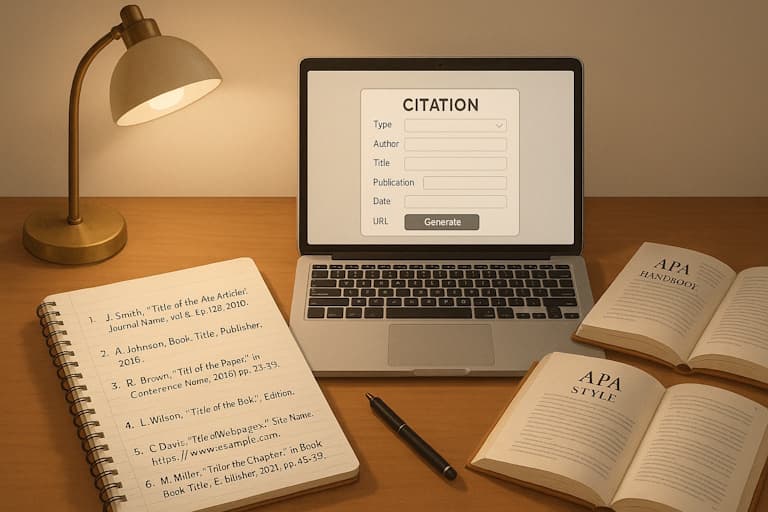
Best Practices for AI-Generated Citations
Learn how to use AI citation tools responsibly by verifying sources, understanding style requirements, and maintaining transparency in your academic work.
AI tools can simplify citation tasks like formatting references, generating bibliographies, and suggesting sources. But relying on them without proper oversight can lead to errors. Fabricated sources, incorrect formatting, or missing details can harm your credibility and breach academic integrity.
To use AI citation tools responsibly:
- Understand your institution's policies on AI usage and disclosure.
- Verify every citation against original sources to ensure accuracy.
- Know your required citation style (APA, MLA, Chicago, IEEE) and check AI outputs for compliance.
- Document your workflow to maintain transparency and accountability.
AI tools are helpful for repetitive tasks, but human review is essential to avoid errors and maintain academic integrity. Always cross-check AI-generated citations, disclose tool usage when required, and stay updated on evolving guidelines.
Preparation Before Using AI Citation Tools
Getting ready to use AI for generating citations isn't just a technical step—it's a critical part of ensuring your work meets academic standards. Skipping this preparation phase can lead to errors, policy violations, or even questions about your academic integrity. By taking the time to review policies, understand citation requirements, and choose the right tools, you can avoid unnecessary complications down the road.
Review Institutional Policies
Start by checking your syllabus, student handbook, and honor code for any rules about using AI tools. If the guidelines are unclear, reach out to your advisor or professor for clarification. Remember, even if you use AI for assistance, you are ultimately responsible for the accuracy of your citations—AI tools cannot take the blame for errors.
Some schools may require you to disclose when you've used AI, while others might insist on getting approval before using certain technologies. Ignoring these rules can lead to academic integrity violations, even if your citations themselves are correct. It's better to be safe than sorry.
Determine Required Citation Styles
Make sure you know which citation style your assignment requires. For example:
- APA is common in the social sciences.
- MLA is often used in humanities.
- Chicago/Turabian is versatile and used across many disciplines.
- IEEE is standard for engineering and technical fields.
Double-check your assignment instructions to ensure your chosen AI tool supports the most current version of the required style. Citation rules can change quickly, so what worked a year ago might not be acceptable now. Staying up-to-date will help you avoid unnecessary mistakes.
Once you're clear on the citation style, select tools that are known for their accuracy and ease of use in formatting those specific styles.
Choose the Right Tools and Workflow
With compliance and citation style requirements in mind, pick tools that meet your needs while ensuring accuracy. AI citation tools come in different forms:
- Dedicated citation managers: These focus solely on organizing and formatting references.
- General-purpose AI writing tools: These often include citation features along with drafting and editing capabilities but may require closer scrutiny since they're more prone to errors like fabricating sources or misformatting details.
No matter which tool you use, always double-check the citations it generates. AI tools can make mistakes, such as misnaming authors, getting publication dates wrong, or—even worse—creating completely fictional sources. Your workflow should include comparing every citation to the original source material. Verify details like author names, publication year, title, volume and issue numbers, page ranges, and URLs.
For added reliability, consider a hybrid approach. Let AI handle the repetitive formatting work, but maintain your own record of sources in a spreadsheet or document. Note where you found each source, the date you accessed it, and why it's relevant. This not only helps with verification but also provides a clear record of your research process if questions arise later.
Finally, think about how the tools fit into your writing environment. If you're using Microsoft Word, Google Docs, or LaTeX, make sure your chosen citation tool integrates seamlessly. Some citation managers even offer browser extensions that can automatically collect source details as you research online, which can save you a lot of time and effort.
Checklist for Generating Accurate AI-Assisted Citations
When using AI tools for citations, it's crucial to approach the process with care. AI-generated citations are a helpful starting point, but they always need thorough verification to meet academic standards. Here's a checklist to ensure your citations are accurate and reliable.
Core Formatting and Verification
Every citation should include key details: author, year, title, source, and, when available, a DOI or URL. Make sure that every in-text citation corresponds to an entry in the bibliography. For instance, if you reference "Johnson, 2022" in your text, there must be a matching entry in your reference list.
Pay attention to the nuances of punctuation, capitalization, and italicization. Citation styles like APA and MLA have distinct rules—for example, APA only capitalizes the first word of article titles, while MLA capitalizes all major words. AI tools often mix these up, especially if they've been trained on multiple style guides.
Double-check details like page numbers, volume numbers, and issue numbers. For example, APA formats these as "15(3), 45-67" for volume 15, issue 3, pages 45-67, while MLA uses a different approach. Always verify these elements against the original source and your discipline's official style guide.
Once the basics are in place, refine the citations to align with the specific rules of your required style.
Style-Specific Guidelines
Each citation style has its own particular rules, and AI tools don't always get them right. Understanding these differences can help you catch common errors.
- APA Style: Be cautious with author formatting. The 7th edition of APA uses "et al." for in-text citations with three or more authors but lists up to 20 authors in the reference list before using ellipses. Also, ensure DOIs follow the correct URL format (e.g.,
https://doi.org/10.xxxx/xxxxx) instead of the outdated "doi:" prefix. - MLA Style: Pay close attention to how AI handles containers, which refer to the larger works housing your source. For instance, a journal article's container is the journal itself, while a book chapter's container is the book. MLA also requires specific punctuation between elements, which AI tools often misplace. Don't forget to include the version or edition of a source when it applies, as MLA now mandates this detail.
- Chicago Style: The main challenge lies in distinguishing between the notes-bibliography and author-date systems. Ensure the AI-generated format matches your assignment requirements. Additionally, Chicago has specific rules for citing sources without traditional publication details, like websites or social media.
- IEEE Style: This style uses numbered citations in brackets (e.g., [1], [2]). AI tools sometimes confuse IEEE with other numbered systems, so double-check formatting. IEEE also has strict rules for abbreviating journal names and citing technical reports, which are especially important in fields like engineering or computer science.
Verify Accuracy and Prevent Fabrications
Once formatting and style are sorted, it's time to ensure the citations are grounded in reality. AI tools are known to generate fabricated citations, often referred to as "hallucinations." These can look convincing but may reference nonexistent sources, complete with plausible author names, journal titles, and publication years.
To prevent issues:
- Consult Original Sources: Always verify that author names, titles, publication years, and page numbers match the material you're citing.
- Use Reliable Databases: Cross-check citations with trusted platforms like Google Scholar, PubMed, JSTOR, or your university library's catalog. If a citation doesn't appear in multiple searches, it's likely fabricated and should be replaced with a legitimate source.
- Test DOIs and URLs: Ensure they lead to the correct publication. AI tools may generate DOIs that look valid but don't resolve to any actual content.
- Be Cautious with Obscure Sources: AI is more likely to fabricate citations for hard-to-verify materials, such as older conference proceedings or articles from lesser-known journals.
Keep a record of your research process, including where and how you retrieved each source. This documentation not only helps you retrace your steps but also serves as evidence of your diligence if questions about your citations arise.
Finally, when in doubt, consult a librarian. Academic librarians are skilled at verifying sources and can help you resolve questionable citations or suggest alternatives if needed. Their expertise is invaluable for ensuring the integrity of your references.
Ethical Use, Attribution, and Disclosure
When using AI tools for citations, transparency and accountability are non-negotiable. Academic integrity hinges on being upfront about how these tools are utilized and ensuring proper acknowledgment of sources. Openly disclosing AI assistance not only protects your credibility but also upholds the trust within the academic community.
When to Cite AI vs. Disclose Its Use
Figuring out when to cite AI versus when to simply disclose its use can be tricky. Here's a simple rule: if the AI tool directly contributes ideas or content, cite it. If it assists with tasks like brainstorming or formatting, disclose its involvement.
For instance, if you include an AI-generated response in your work—such as writing, "According to ChatGPT, the primary benefit of renewable energy is..."—you need to provide a formal citation in your references. Some style guides are already introducing specific formats for citing AI-generated content.
Additionally, many academic journals and institutions now require you to acknowledge or include a methods statement detailing how AI tools contributed to your work. When in doubt, follow your institution's policies and err on the side of disclosure. This approach ensures transparency and maintains trust in your academic contributions.
Maintaining Academic Integrity
AI tools can sometimes produce fabricated citations, which can seriously damage both your work and your academic reputation. Always cross-check every citation with the original source to confirm its accuracy. Failing to do so could undermine your credibility.
Keeping detailed records of your interactions with AI tools—such as prompts, responses, and any edits you make—can also enhance transparency. These records are invaluable if you need to clarify your methods later. If an AI tool helps you grasp a complex idea that you then explain in your own words, it's worth acknowledging its role in your methodology. Always verify AI-generated citations to ensure they're accurate and reliable.
Improving Clarity with Human Writes

To ensure your disclosures are clear and professional, it's essential to use language that flows naturally. Overly technical or clunky explanations can confuse your readers. This is where Human Writes can be a game-changer.
Human Writes specializes in refining AI-generated disclosures, transforming them into polished academic text. Their free trial, which covers up to 500 words, is perfect for short sections like acknowledgments, disclosure statements, or methodology explanations. For longer sections, upgrading to the full version ensures consistency throughout your paper.
Using clear, human-like language not only meets academic standards but also strengthens trust in your citation practices. Tools like Human Writes help you blend AI-generated content seamlessly with your own voice, ensuring your work is both professional and transparent.
Final Review and Documentation
The final review is your chance to make sure your citations align with academic standards and can stand up to scrutiny. This step not only checks for consistency but also helps you create a clear record to support your citation choices.
Consistency and Completeness Checks
Double-check that every in-text citation matches a corresponding reference entry with accurate details. Carefully review the document to ensure that author names, publication dates, and page numbers are consistent between the main text and the reference list.
Pay extra attention to style consistency throughout your work. If you're using APA format, for instance, stick strictly to APA rules—avoid mixing in elements from MLA or other styles. AI tools sometimes switch between formats or combine rules, so a manual review is essential. Look at punctuation, capitalization, and italicization to ensure they're applied consistently across all citations.
Make sure your citations meet U.S. formatting standards. Verify that all required elements—like page numbers, volume and issue numbers, DOIs, or URLs—are included without exception.
Keep a Citation Log
Once your citations are accurate, document your process to maintain transparency. A structured citation log can protect you from future questions about your sources or methods.
Record each source in detail, including any AI prompts you used, generated citations, and manual edits you made. Your log should include columns for the author, title, publication details, access date, and any notes about verification. If you relied on an AI tool to format or locate a citation, note which tool you used and when.
This log can be a lifesaver if you need to revisit your research months later or if someone questions a specific citation. Instead of scrambling to remember how you found a source, you'll have all the information documented. It can also reveal patterns—like if AI tools consistently make the same errors for certain types of publications—allowing you to refine your process.
Use tools you trust to maintain your citation log and keep it organized alongside your research notes and drafts. Having everything in one place ensures it's easy to access whenever needed.
Stay Updated on Policies
Citation guidelines and AI-related policies are constantly changing, so it's important to stay informed. Before starting any new project, review the latest style guides and institutional rules.
Major style guides like APA, MLA, and Chicago are actively updating their recommendations for citing AI-generated content. As of January 2026, these guidelines are still evolving. Check their official websites regularly or subscribe to their newsletters if available for updates.
Your institution's policies on AI use are just as important. Many universities have revised their academic integrity guidelines to address AI tools, often including specific disclosure and citation requirements. Check your department's website, consult your institution's writing center, or talk to your advisor to ensure you're adhering to the latest rules.
Additionally, professional organizations in your field may provide helpful recommendations. Whether you're in the sciences, humanities, or social sciences, look for guidance from relevant disciplinary associations. These groups often offer field-specific advice that complements general citation rules.
Make it a habit to review these policies at the start of each semester or before beginning a major research project. Staying current not only keeps your work compliant but also demonstrates your commitment to academic integrity and responsible AI use.
Conclusion
AI tools can make citation formatting faster and more efficient, but they require careful human oversight. Speed is only valuable when paired with accuracy and integrity, and effective citation practices demand a balance between the convenience of AI and the diligence of human review.
AI-generated citations must always be verified thoroughly. These tools can sometimes invent sources or misformat details, highlighting the importance of human scrutiny. Since AI outputs lack accountability, it's crucial to disclose their use and ensure every citation meets academic standards to uphold integrity.
Being transparent about AI usage fosters trust in your research. Readers need to understand how AI was involved to properly evaluate and replicate your work. Whether you're directly citing AI or explaining its role in your methodology, open communication about your process is key.
Citation standards are constantly evolving. Guidelines that apply today may change as style guides and institutional policies adapt to new technologies. Staying informed and flexible demonstrates your dedication to responsible academic practices.
Platforms like Human Writes can help navigate these challenges by improving clarity and maintaining an academic tone. Its AI detection and rewriting tools are tailored for academic contexts where precision and authenticity are essential.
The best citation practices combine AI's efficiency with critical human oversight. While AI can handle formatting, it's up to you to verify every detail. This balanced approach ensures your academic reputation remains intact while you reap the benefits of modern tools.
FAQs
What are the best ways to ensure AI-generated citations follow the latest style guidelines?
When working with AI-generated citations, it's crucial to double-check their accuracy. Always verify the sources and ensure they align with the required citation style, whether it's APA, MLA, or Chicago. Never rely solely on AI tools for citations without reviewing the original materials to confirm their validity.
If you're uncertain, it's a good practice to acknowledge the use of AI tools in your work and adhere to any specific rules set by your institution or publisher. Keeping up-to-date with changes in citation standards ensures your references remain reliable and credible.
What should I do if I think an AI-generated citation is incorrect or made up?
If you think an AI-generated citation might be incorrect or made up, the best approach is to double-check it against reliable sources like academic journals, books, or well-established websites. Try to locate the original source mentioned in the citation to ensure it's accurate.
As you verify, focus on key details such as the publication date, the author's credentials, and how relevant the source is to your topic. If you can't confirm the citation's accuracy, it's better to leave it out and look for a more trustworthy source through additional research.
How should I disclose the use of AI tools in my academic work to stay transparent and ethical?
To ensure transparency and uphold academic integrity, it's important to disclose when AI tools play a role in your work. Be specific—cite the AI tool you used and include a clear explanation in your methodology or notes about how it contributed. This approach keeps your work ethical and helps avoid any misunderstandings.
Related Articles
- Best Practices for Integrating AI-Generated References
- Checklist for Ethical AI Use in Academia
- How to Rewrite AI Text for Peer-Reviewed Journals
Need help refining your AI-generated citations and disclosures? Try Human Writes to ensure your academic writing is clear, professional, and transparent.